Stronger campuses. Safer communities.
Coordinated, trauma-informed campus response from first disclosure through medical-forensic care, built on a Comprehensive Sexual Assault Response and Referral (C-SART) program designed with your team.
- 1Define the scopeC2C and your institution agree the campus locations, populations, participating services and criteria version the review covers, in writing.
- 2Verify readinessDocument review, interviews with personnel and partners, at least one observed multidisciplinary simulation and one tested medical-access and handoff pathway.
- 3Rate the evidenceEach of the 16 criteria is scored 0 to 3. Designation needs 39 of 48 points, every core criterion at 2 or more, and no unresolved critical finding.
- Sealed and listedA written award valid for one year, a verification ID, the flag and decals, and a page in the public directory that families can check.
Sixteen criteria, four domains
The 16 criteria in this standard address leadership, partnerships, access to services, workforce readiness, realistic practice, accessibility and continuous improvement. Policies and training records are considered alongside evidence that the response works in practice.
C2C Clinical & Forensic Consulting LLC owns and administers the designation. C2C may help a campus prepare and also conduct its designation review. Education or consulting fees do not guarantee an award; designation decisions are based on the published criteria and documented evidence.
Read the Public Standard- 01Response ownership
- 02Campus-community partnershipCore
- 03Multidisciplinary response teamCore
- 04Role clarity
- 05Victim-service accessCore
- 06Medical-forensic accessCore
- 07Closed-loop handoffCore
- 08Immediate safety and choiceCore
- 09Role-based educationCore
- 10Knowledge verification
- 11Simulation and practiceCore
- 12Nursing and healthcare preparedness
- 13Accessible response
- 14Response confidence
- 15Quality review
- 16Continuous improvementCore
Coordinated response planning is the cornerstone of a trauma-informed campus culture.
C2C specializes in the development and implementation of Comprehensive Sexual Assault Response and Referral (C-SART) programs. Our approach integrates clinical expertise with forensic integrity to ensure a seamless, patient-centered pathway from disclosure to medical-forensic care and legal support.
- Clinical Examination SimulationHands-on training for forensic nurses and medical staff.
- Coordinated Response DrillsJoint exercises for law enforcement and healthcare teams.
- Evidence DocumentationPrecision training in forensic photography and evidence collection.
- University Training ProgramsInterdisciplinary education for campus safety and victim care.
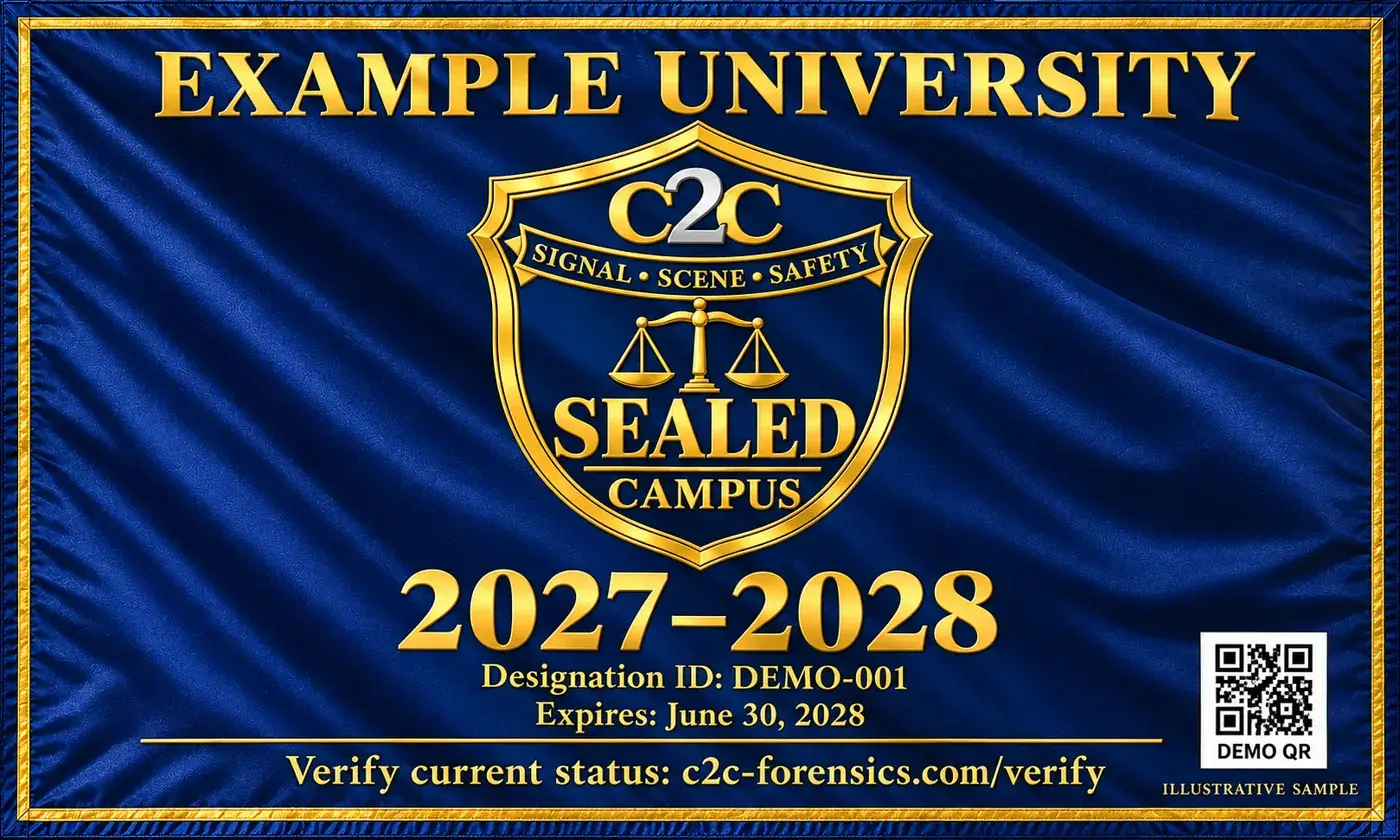
The flag, the decals and the page
- A campus flag with your school name, verification ID and the year it covers, and the verify address printed on it.
 Door decals for the Title IX office, health services and every office in the response plan. Die-cut vinyl, eight inches tall.
- A public page in the Sealed Campus directory that families can check any time.
- The Sealed Campus shield for your website and admissions materials, for as long as the designation is current. Suspended, revoked or expired campuses stop displaying it.
Sealed Campus directory
- No campuses are listed yet.A campus appears here once its review is under way and C2C lists it, and it stays here with its current status for as long as it holds the designation.See what the designation takes
- Verification ID
- C-XXXX-XXXX
- Sealed since
- To be confirmed
- Expires
- To be confirmed
- Where to get help
- Ask the campus Title IX office
Questions campuses ask
- What does Sealed Campus involve?
- Sixteen published criteria in four domains: leadership, governance and partnerships; survivor access and completed handoffs; workforce readiness and performance; and equity, measurement and improvement. C2C reviews documents, interviews personnel and partners, observes at least one multidisciplinary simulation and tests at least one medical-access and handoff pathway. A nursing program is not required.
- How is the designation scored?
- Each criterion is scored 0 to 3. Designation requires at least 39 of 48 points, a score of at least 2 on every core criterion (2, 3, 5, 6, 7, 8, 9, 11 and 16), and no unresolved critical finding. Strong performance in one area cannot offset an unmet core requirement. The award is valid for one year and renewed through review.
- Does paying for C2C's help guarantee the designation?
- No. C2C may help a campus prepare and also conduct its review, but education or consulting fees do not guarantee an award. Decisions are based on the published criteria and documented evidence.
- What shows on the public directory page for our campus?
- Your campus name, status, verification ID, the date it was sealed, the expiration date and the public contact for your Title IX or support office. The record never discloses survivor identities or case details.
- Who on our campus gets a sign-in?
- The people you name, usually the Title IX coordinator or campus safety lead. Genelle invites them by email. They see your campus criteria list, upload evidence to private storage and read Genelle's comments.